
Coaching or Therapy:
Which fits best for you?
Coaching and therapy have different ways of supporting your growth. Coaching meets you where you are and moves you forward with clarity and confidence, while therapy helps you understand and heal what’s deeper beneath the surface. Both offer invaluable help for growing healthier humans.
A lot of people assume that if something feels off, they must need therapy. Sometimes this is absolutely true. And other times there's an option you may have never considered.
In my practice, clients often arrive with a head full of challenges: past trauma, diagnoses, family patterns, and hard things they’ve lived through. When we’re told to “fix what’s wrong” or to "get help", we naturally go digging for the whys, and therapy is powerful in discovering that. But coaching is different, and it's the option most people never knew existed. It meets you where you are right now and helps you move forward toward what you're wanting without labels, without getting lost in your past, and without band-aid quick fixes.
Understanding How Coaching Fits Into the Picture


My promise: I coach clients for practical solutions and long-term change. If we hit something that’s better suited to therapy I’ll let you know, and you’ll walk in to therapy with a stronger foundation to do the deeper work of emotional healing.
The Focus of Coaching
Coaching is forward-facing. We work with the present patterns of how your nervous system has been wired and we use the concept of neuroplasticity to create new, effective ones.
What Coaching Develops:
Awareness: Understand where you're really getting stuck and learn to shift these patterns.
Confidence: Get comfortable with who you really are and learn to maximize your best parts, while shifting the challenging ones.
Alignment: Reconnect to what matters most to you and grow into your favorite version of yourself, life, and relationships.
Perspective: Learn to view challenges differently and tap into your intuition, so new solutions appear more easily.
Ease: Build steadiness and calm within yourself that you can access any time, even when life is unpredictable.
My integrative approach to life and relationship coaching blends mindfulness and applied neuroscience, built through my training at Duke Integrative Medicine, relationship coaching certifications, and experience with hundreds of clients. I listen for your thought process, body language, and patterns that often go unnoticed, because these hold the keys to getting you unstuck.
You’ll leave with each session with increased clarity, new insights, and forward momentum. Over time the coaching process builds new neurological pathways and creates sustainable change. You’ll find you need me less as we go on, as you grow the inner skills to coach yourself through daily life.
The Focus of Therapy
Therapy explores, heals, and treats mental health challenges and emotional wounds. Therapists are licensed to work within a clinical scope with therapy often involves processing the past and developing emotional regulation skills. Coaching does not diagnose or treat mental illness, this is beyond its scope.
Therapy is the best first step when:
You experience persistent, impairing symptoms of anxiety, depression, PTSD, or other diagnoses
You have unprocessed trauma or grief that regularly overwhelms you
You have safety concerns, are in crisis, or have thoughts of harm to yourself or others
You need a diagnosis, medication evaluation, or clinical treatment
Please note: If you feel unsafe or in crisis, contact local emergency services or the 988 Lifeline immediately.
When Coaching Is A Great Fit
Coaching and therapy can feel very different, which is a good thing. Each has its own purpose, rhythm, and focus.
Having personally participated in and also being trained by both therapists and coaches, I offer a unique perspective on the differences between the two.
I’ve found that sometimes therapy can be like opening up a can of worms and examining each one carefully. This is essential when the worms need attention, understanding, and healing. Coaching, on the other hand, notices the can and asks “What about these worms matters right now?” and helps you move forward using what’s relevant to your current challenge.
You can also think of it this way: if you’re stuck in a hole, therapy helps you understand how you got there and heal what’s been keeping you in the hole. Coaching helps you move away from the hole and keep growing.
Consider coaching when:
You’re functional but stuck in overthinking, overwhelm, or feel off-track
You want direction, momentum, and habits that actually stick
You’re ready to work with your patterns, not against them
You want to feel lighter, clearer, and more yourself without digging into the past
You've already done therapeutic work and are ready to integrate what you learned back into daily life
You want to build self-awareness, stability, and confidence with or without the potential for doing therapeutic work afterwards

If we discover something during coaching that we can’t move past and that’s better suited for therapy, we’ll pause there and have you change course. And you’ll be able to move into your therapeutic work from a foundation of greater clarity and confidence. Also, some clients prefer to continue their coaching course and add on therapy, letting the two work together to help them from different angles.
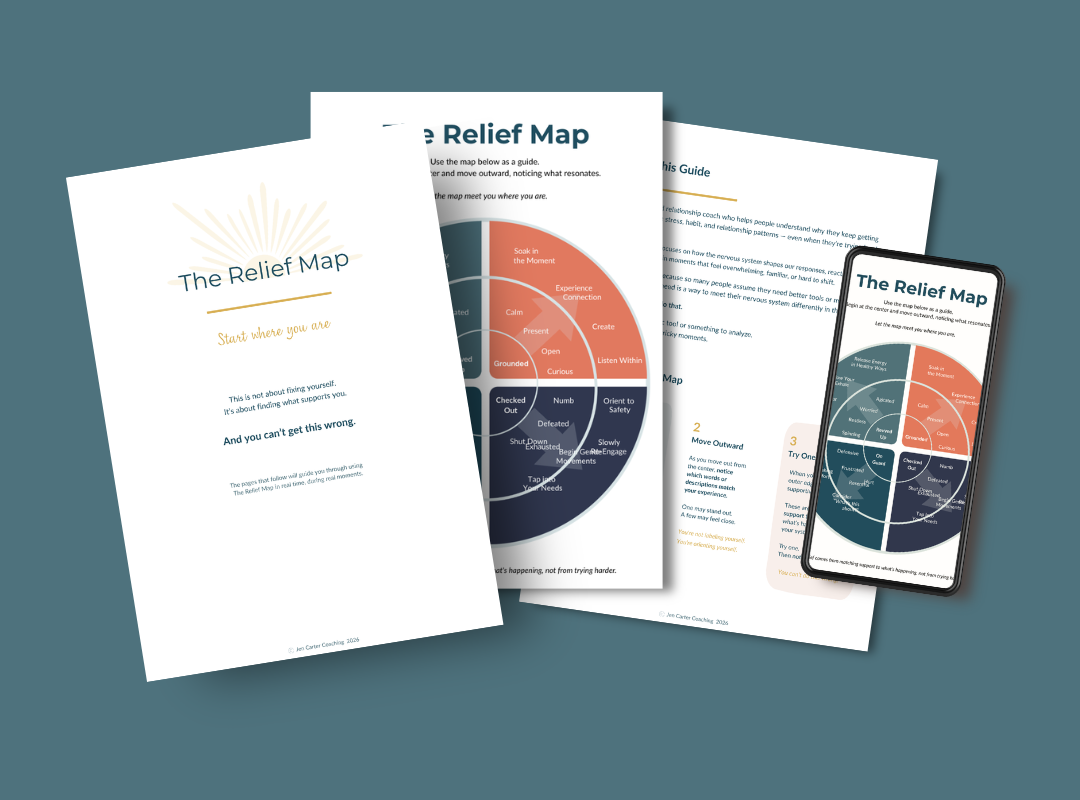
FREE GUIDE
Discover a simpler way to get unstuck and feel steadier, without forcing yourself to change
The real question isn’t just “coach or therapist” but which coach or therapist. Just as not all hairdressers, builders, or medical providers are equal, coaches come with different levels of training, expertise, experience, and approaches.
Important factors you should look for in a coach:
All Coaches Are the Same, Right?
-
Look for an experienced coach who is well trained in the skills of coaching with hands-on training, not just knowledge, as certified coaches can have vastly different qualifications.
-
Ensure the coach you choose has practiced in the areas you want to impact: career, life, relationships, health, transitions, business, etc.
-
Ask the coach you’re considering about their scope of practice and when they refer to therapy or other professionals.
-
The benefit of coaching is that it can be a personalized approach rooted in sustainable transformation, not quick fixes or “one size fits all” approaches. This is not a given for all coaches, as some act more as consultants, giving plans and advice, than true coaches.
-
Find a coach who can support you in ways that align with you, challenge you to grow, and help you develop new viewpoints and patterns.
-
Authentic coaching is open minded and does not apply judgments to their clients such as classifications, labels, prescriptions, or advice. They are there to guide you on your completely unique path through life.
-
In coaching, just like dating, it’s essential to ensure a great fit. When finding a coach consider: comfort, relatability, trust, reliability, communication style, in-person vs virtual, experience, etc.
Common Focuses of Coaching

For clients who’ve already built a full life or career but feel ready for a new chapter, coaching becomes a place to pause, re-align, and intentionally choose what’s next.
-
“My coaching experience with Jen was nothing short of deeply transformative for me as well as for my business.
I’m at the stage of life that I needed to find a new perspective on where I’d arrived and be mindful about how I wanted to move forward thru it. I am so grateful I found her and her style of coaching, it was the perfect answer for me.
I’ve referred a few very close friends and some colleagues to her and know that she’s been instrumental in helping them as well.
Her approach is quite different from conventional “therapy” and she somehow locks right in on how to help in a fundamental and uniquely personal way. She’s amazing!! ~Vickie

For those standing at a crossroads; whether from a divorce, loss of a loved one, retirement, relocation, or a reinvention, coaching helps clients navigate uncertainty in moving forward with clarity and confidence.
-
“Coach Jen Carter has been a critical source of guidance and support for me as I move through a major transition in my life and open to new horizons.
Her intelligence, dedication, superlative skills, and good humor have all combined into a prodigious force for good in my life. I feel so very grateful to have located her.
I recommend her services unconditionally and with the greatest possible enthusiasm to anyone seeking greater clarity and greater fulfillment in their lives. Thank you Coach Carter!” ~Roger

High-achieving professionals often seek coaching when success on paper doesn’t feel balanced, aligned, or like it's enough. Or when there’s just too much to make sense of.
-
“Jen helped me identify what balance looks like for me and helped me define action steps to achieve better balance in my life. She helped me learn that self-awareness requires introspection and reflection, and has helped me work on building these skills.
Jen creates accountability. I have an ally that holds me to my word and ensures goals important to me get pursued.” ~Beth

Many clients begin coaching simply knowing something needs to change. They’re ready to reconnect with themselves, shift their perspective, and start living more intentionally.
-
“Finding Jen is the best thing that I have done for myself, ever! It has been an eye opening experience. Introspective and real.
I would not be where I am at today without knowing her. And there is more to come!” ~Elizabeth
FAQ’s
-
In addition to the information on this page, ask yourself:
Am I functional but stuck? Then coaching is a good fit.
Am I overwhelmed with mental health symptoms or trauma? You should start with a good therapist. -
Coaching can be helpful in many ways in moving your forward and supporting growth and change, but it doesn’t treat mental health conditions or process trauma.
Therapy and coaching can complement each other beautifully, however. Many clients find that coaching is helpful to move them forward when they stop progressing in therapy. Other clients find coaching to provide a necessary foundation before they enter into deep therapeutic work.
-
Coaching supports behavior and pattern change and can impact anxiety, however, coaching does not directly treat mental health conditions.
When clients come to coaching and state they have anxiety, the first question I ask them is "What's the anxiety?".
This is a different approach, as we explore what’s driving the worrisome thoughts and emotions, and work to change these patterns.
-
Absolutely. I've had clients benefit from having both services concurrently, each supporting one another while serving different purposes.
-
Every person is unique and comes for a reason, a season, or to stay. Many clients work with me for 3–6 months, others pop in for just a few sessions, and some prefer to stay longer as coaching becomes a "must have" in their life.
In coaching I never "graduate" you, you are in control and coach for as long as you would like. And my clients who move on always "keep me in their back pocket" in case they need my guidance in the future.
-
I was trained in integrative coaching by both coaching others and being coached myself, so I have been where you are. And due to my natural curiosity, I tend to focus a bit deeper than most coaches, targeting the roots of your challenges.
I use mindfulness, the neuroscience of behavior change, mind-body psychology, and intuition to connect the dots of what's really going on, help you truly understand yourself, and move you towards fulfilling, sustainable changes with yourself, your life, and your relationships.
-
The big question, right?
Coaching is not recognized by insurance as a covered benefit. However, since my coaching integrates all aspects of your life, I've had numerous business owners, executives, and employees had coaching covered as a work expense.
Other clients have used HSAs or FSAs for payment (check with your account).
-
My coaching clients fall into a few different categories:
•they love growth and self-help work and can’t wait to do more
•they’ve never considered growth work before, but now they’re struggling and want things to change
•they’ve tried growth work before, often therapy, and it didn’t work for them
• they’ve done, or are doing, other growth work and want to add in a forward facing focus
No matter where you begin, I’ve seen all kinds of clients make impactful progress. They often leave sessions saying they feel “better”, “lighter”, or things feel “easier” and that “our hour together was extremely helpful”.